

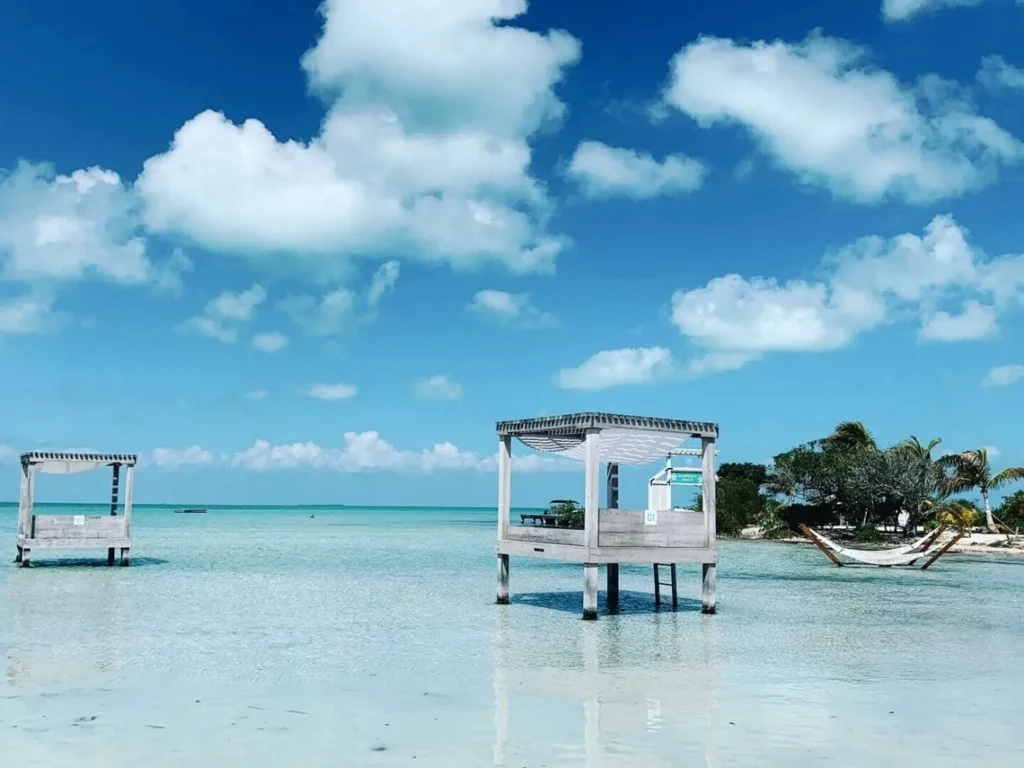
Belize is located on the northeastern coast of Central America. Its territory is bordered on the northwest by Mexico, on the east by the Caribbean Sea where you can find it’s extensive barrier reef, and on the south and west by Guatemala. Belize has a very diverse society that is composed of many cultures and languages that reflect it’s rich history.
Before becoming a British colony, Belize was home to the Maya civilization, which flourished until about the 1200. Several Maya ruin sites reflect the advanced civilization and much denser population of that period. Many aspects of this culture persist in the area despite nearly 500 years of European domination. Spanish conquistadors and missionaries made the first recorded European incursions in the region in the 16th century, who nevertheless failed to establish colonial rule. European settlement was begun by English settlers in 1638. The 18th century in Belize was marked by frequent conflict between Britain and Spain and the arrival of African slaves to British plantations. In 1862 Belize was formally named “Colony of British Honduras” to later become a “Crown Colony” in 1871.
British Honduras faced two obstacles to independence: British reluctance until the early 1960s and Guatemala’s long-standing claim to the entire territory. By 1961, Britain was willing to let the colony become independent but continued to control only British Honduran defense, foreign affairs, internal security, and the terms and conditions of the public service. In 1973 the colony’s name was changed to Belize in anticipation of independence. Finally, in November 1980, with Guatemala completely isolated from the Latin American governments support, the UN passed a resolution that demanded the independence of Belize, achieved on 1981.
The undulating courses of two rivers, the Hondo and the Sarstoon River, define much of the course of Belize’s northern and southern boundaries. The western border follows no natural features and runs north-south through lowland forest and highland plateau. The north of Belize consists mostly of flat, swampy coastal plains, in places heavily forested. The flora is highly diverse considering the small geographical area. The south contains the low mountain range of the Maya Mountains.
The coastal area of Belize is an outstanding natural system consisting of the largest barrier reef in the northern hemisphere, offshore atolls, several hundred sand cays,mangrove forests, coastal lagoons and estuaries. The system’s seven sites illustrate the evolutionary history of reef development and are a significant habitat for threatened species, including marine turtles, manatees and the American marine crocodile.
Travelers at increased risk for severe illness from COVID-19 should avoid all nonessential travel to Belize.
If you travel to Belize, get fully vaccinated before travel.
Even fully vaccinated travelers are at risk for getting and spreading new COVID-19 variants. All travelers should wear a mask, stay 6 feet from others, avoid crowds, and wash their hands.
A valid passport is required for entry to Belize and re-entry into the United States. Each passenger should be sure that his or her passport has at least six months of remaining validity from the date of return to the USA.
Currently, no advance visa is required for US citizens who are visiting Belize as tourists. Prior to arriving at your destination, the airline flight attendants will give you an immigration form that must be completed and presented to a national immigration officer in order to be granted a tourist visa. You must save a copy of this stamped form, as you will have to surrender it to immigration officials when you check in for your flight home.
A customs declaration form for both the outbound and inbound international flights will also be handed out by the airline flight attendants and should be completed before landing. You only need to fill out one form per family.
When paying by credit card, vendors and restaurants may require your passport number. You may wish to photocopy your passport photo page, keeping it with you at all times, while locking your passport in the hotel safe.
The Centers for Disease Control and Prevention (CDC) has issued a Level 2 Travel Health Notice for Belize due to COVID-19, indicating a moderate level of COVID-19 in the country. Visit the Embassy’s COVID-19 page for more information on COVID-19 in Belize.
If you decide to travel to Belize:
In Belize, the local currency is the Belizean Dollar. The exchange rate is fixed at 2 Belizean Dollars to 1 US Dollar (subject to change without notice). ATMs are located in Belize City and larger towns. Ambergris Caye also has ATMs in San Pedro town, although cash may be difficult to obtain from these ATMs on weekends.
If you are bringing currency from the USA, bring notes that are crisp and without tears; torn and worn bills may not be accepted. Denominations above US$20 are not widely accepted. Please confirm your travel dates and destinations with your card issuers before you leave the USA.
Most Belizeans are of multiracial descent. About 52.9% are Mestizo, 25.9% Creole, 11.3% Maya, 6.1%, Garifuna, 3.9% East Indian, 3.6% Mennonites, 1.2% White, 1% Asian, 1.2% Other and 0.3% Unknown.