


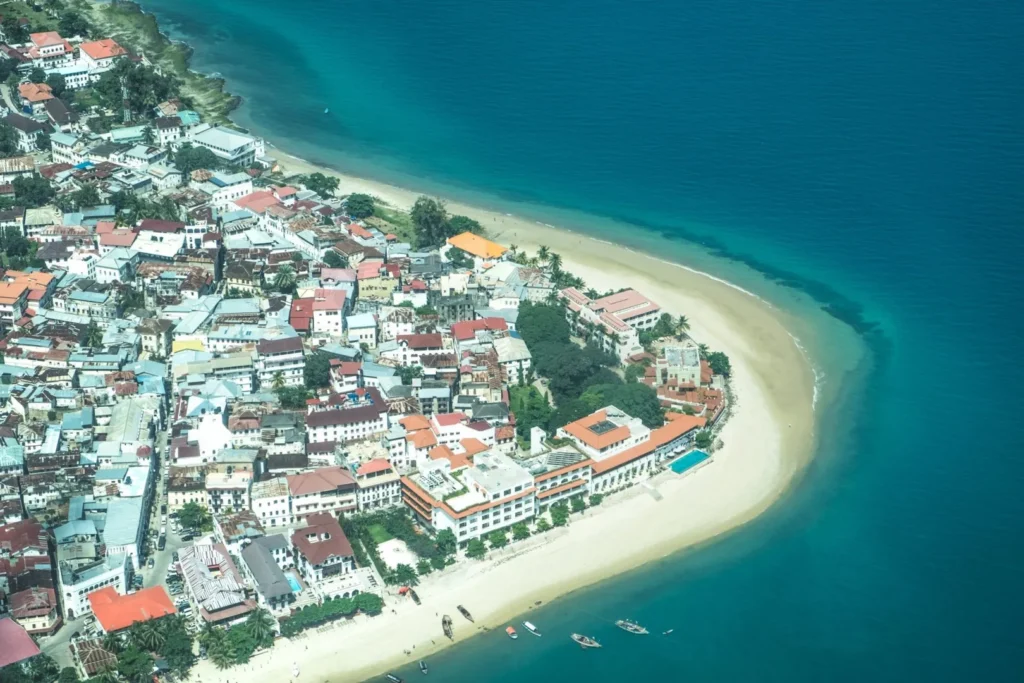
The United Republic of Tanzania is located in Central East Africa being bordered by; Kenya and Uganda to the North; Rwanda, Burundi, and the Democratic Republic of the Congo to the West; Zambia, Malawi, and Mozambique to the South; and the Indian Ocean on it’s Eastern borders.
The United Republic of Tanzania is composed of 26 regions. For the past 12 years, Dodoma has served as the capital city. However, prior to 1996, the coastal city of Dar es Salaam served as the capital, and today most governmental offices are located there. In addition, Dar es Salaam serves as the major seaport for the country and most land-locked neighboring countries.
Tanzania is known as one of the oldest continuously inhabited places on Earth; fossil remains of humans and pre-human hominids have been found dating back over 2 million years. Travelers and merchants from the Persian Gulf and West Africa have visited the East African coast since early in the first millennium AD. Sultans moved into the capital city on Zanzibar in 1840, and this became the center for the Arab slave trade. In the late 19th Century, Imperial Germany conquered what is now known as Tanganyika, Rwanda, and Burundi. Post World War I, this area later became a British Mandate, except for Rwanda and Burundi, which were ceded to Belgium. In 1954, Julius Nyerere helped create the first sovereign political party in Tanganyika and British-administered Tanganyika became truly independent in 1961. During the Presidency, Tanganyika became socialist and all banks and large industries were nationalized. After the Zanzibar Revolution overthrew the Arab dynasty, the independent island of Zanzibar merged with mainland Tanganyika in 1964 to form the nation of Tanzania.
Tanzania is mountainous to the Northeast, where Mt Kilimanjaro, Africa’s highest peak is situated. To the North and West are the Great Lakes of Lake Victoria (Africa’s largest lake) and Lake Tanganyika (Africa’s deepest lake). Central Tanzania comprises of a large plateau with plains and arable land. The Eastern shore is hot and humid, with the island of Zanzibar lying just offshore. Tanzania contains many large and ecologically significant wildlife parks including Serengeti National Park (famous for its Great Migration), Ngorongoro Crater (Africa’s great game-filled caldera), and the Selous Game Reserve (considered Africa’s largest game reserve).
Flights from India are currently suspended. However, this does not apply to humanitarian, medevac and repatriation flights. Passengers arriving from India on humanitarian, medevac and repatriation flights are subject to a COVID-19 test upon arrival. They are also subject to quarantine for 14 days at their own expense.
Passengers and airline crew from other countries must have a negative COVID-19 RT-PCR test taken at most 72 hours before arrival, and are subject to medical screening. They must also complete a “Traveler’s Surveillance Form” and present it to the Port Health Authorities upon arrival.
The Centers for Disease Control and Prevention (CDC) has not issued a Travel Health Notice for Tanzania due to COVID-19, indicating an unknown level of COVID-19 in the country. Visit the Embassy’s COVID-19 page for more information on COVID-19 in Tanzania.
Reconsider Travel To:
Mtwara Region in southern Tanzania due to the threat of terrorism.
If you decide to travel to Tanzania:
You are encouraged to carry cash, an ATM or traveler’s check card and a credit card that can be used for cash advances in case of emergency. The best places to exchange money are bureau de change, which are fast, have longer hours and often give slightly better rates than banks. The local currency is Tanzanian Shillings (TSH), but most places accept USD. Better hotels, lodges, and camps will accept credit cards, however it is advised to withdraw cash when visiting remote areas and villages.
About 120 peoples have been categorized into 5 ethnic groups distinguishable by their physical characteristics and languages. About 95% of Tanzanians are classified as Bantu. Tribes range in membership from only a few thousand to the Sukuma tribe, numbering more than 2 million. Other major tribes include the Nyamwezi, Makonde, Haya, and Chagga. The Luo, east of Lake Victoria, are the only people of Nilotic origin; the Maasai of the northern highlands are Nilo-Hamites. A very small number of Bushmen-like people are scattered throughout northern Tanzania, where small tribes of Cushitic origin also live. The inhabitants of Zanzibar and Pemba are descendants of mainland Africans or are of mixed African and Arab extraction. The remaining 1% of the populace is made up of non-Africans, including Arabs, Asians, and Europeans.
Tanzania’s economy is mostly agriculture based. The country has vast amounts of natural mineral resources including gold, diamonds, coal, iron ore, uranium, nickel, chrome, tin, platinum, coltan, and niobium. It is the third-largest producer of gold in Africa after South Africa and Ghana. Tanzania is also known for the Tanzanite gemstones. It also has dozens of beautiful national parks that generate income with a large tourism sector playing a vital part in the economy.
Prolonged drought during the early years of the 21st century has severely reduced electricity generation capacity (some 60 percent of Tanzania’s electricity supplies are generated by hydro-electric methods). During 2006, the country suffered a crippling series of “load-shedding” or power rationing episodes caused by a shortfall of generated power, largely because of insufficient hydro-electric generation. Plans to increase gas- and coal-fueled generation capacity are likely to take some years to implement, and growth is forecast to be increased to seven per cent per year.